


Something was in the air in Madrid.
It was May, and Spain’s capital city was gearing up for the largest tennis event the city had ever seen: The 2012 Mutua Madrid Open.
One of the marquee tournaments in Tennis’ clay-court season, Madrid had played host to the biggest names in the sport for well over a decade. But this tournament was different. In 2012, Madrid was shocking the world with a courageous and colourful move — one that, nearly a dozen years later, is spoken of with equal parts curiosity and criticism.
And it started, as you can probably guess, with a ballsy idea. One proposed by a Romanian Billionaire named Ion Tiriac.
Tiriac’s Tale
Long before he ever commanded a billion-dollar net worth, Ion Tiriac came from humble — albeit unique — beginnings.
Born in Transylvania in 1939, the man later nicknamed “Count Dracula” first rose to prominence as an adolescent ping pong champion. A gifted multi-sport athlete, Tiriac later switched to Ice Hockey, where he earned a spot on Romania’s Olympic team before eventually settling on his real passion: Tennis.
Though he picked up the racquet relatively late — playing his first match at 15 — Tiriac was able to overcome his self-ascribed lack of talent through a “dog-like” work ethic. He turned pro at 19 and would play into his early forties, winning 23 titles, achieving a top-20 world singles-ranking, and taking home a French Open doubles title in the process.
After retiring, Tiriac followed in the footsteps of many tennis greats, first by coaching, then managing, and finally representing several up-and-coming players — the most notable of which was Boris Becker, who went on to win five Grand Slams under his guidance. Despite all of his success, however, it was only after Tiriac began purchasing the licensing to tournaments that he started to accumulate serious wealth.
With licensing under his control, Tiriac was able to dictate when, where, and largely how certain tournaments were staged. After auctioning off a licensing fee to the highest bidder (in this case, municipalities like Madrid), Tiriac was entitled to a substantial cut of ticket sales, sponsorship deals, and broadcasting revenue. It was a huge financial springboard, but one that would pale in comparison to several homegrown businesses that would later catapult him into the stratosphere.
In 1989, after Romania democratized its economic policies, Tiriac established Romania’s first private bank, and later founded a holdings company which invested in retail businesses, airlines, auto-leasing, and insurance.
It was a huge gamble, but it paid off. Almost two decades later, Tiriac’s assets crossed into ten-figure territory, and in 2007, he became Romania’s first billionaire, joining the Forbes list at No. 840.
At the time, Tiriac was easily the richest former-athlete in history, but it didn’t halt his involvement in tennis. He purchased the Madrid Open outright in 2009, planning, with no small degree of confidence, to shape it into one of the sport’s most iconic venues.
Ball Models, Phallic Trophies, and Blue Clay… Oh My!
See, although he was a card-carrying member of the corporate elite, Tiriac was never known for being conservative — in business or life.
In his youth, he unpapologetically played the part of a playboy, so much so that his off-court antics eventually overshadowed his athletic achievements.
Echoing his near-mythological status as a party animal, Arthur Ashe once said that during a shared dinner in Paris, Tiriac “ate a wine glass… and he didn’t bleed.”
Sporting a mop of curly hair and a thick fu manchu, Tiriac also had a commanding presence. The great American writer John McPhee once said of him, “this man has been to places most people do not imagine exist […] Tiriac has the air of a man who is about to close a deal in a back room behind a back room.”
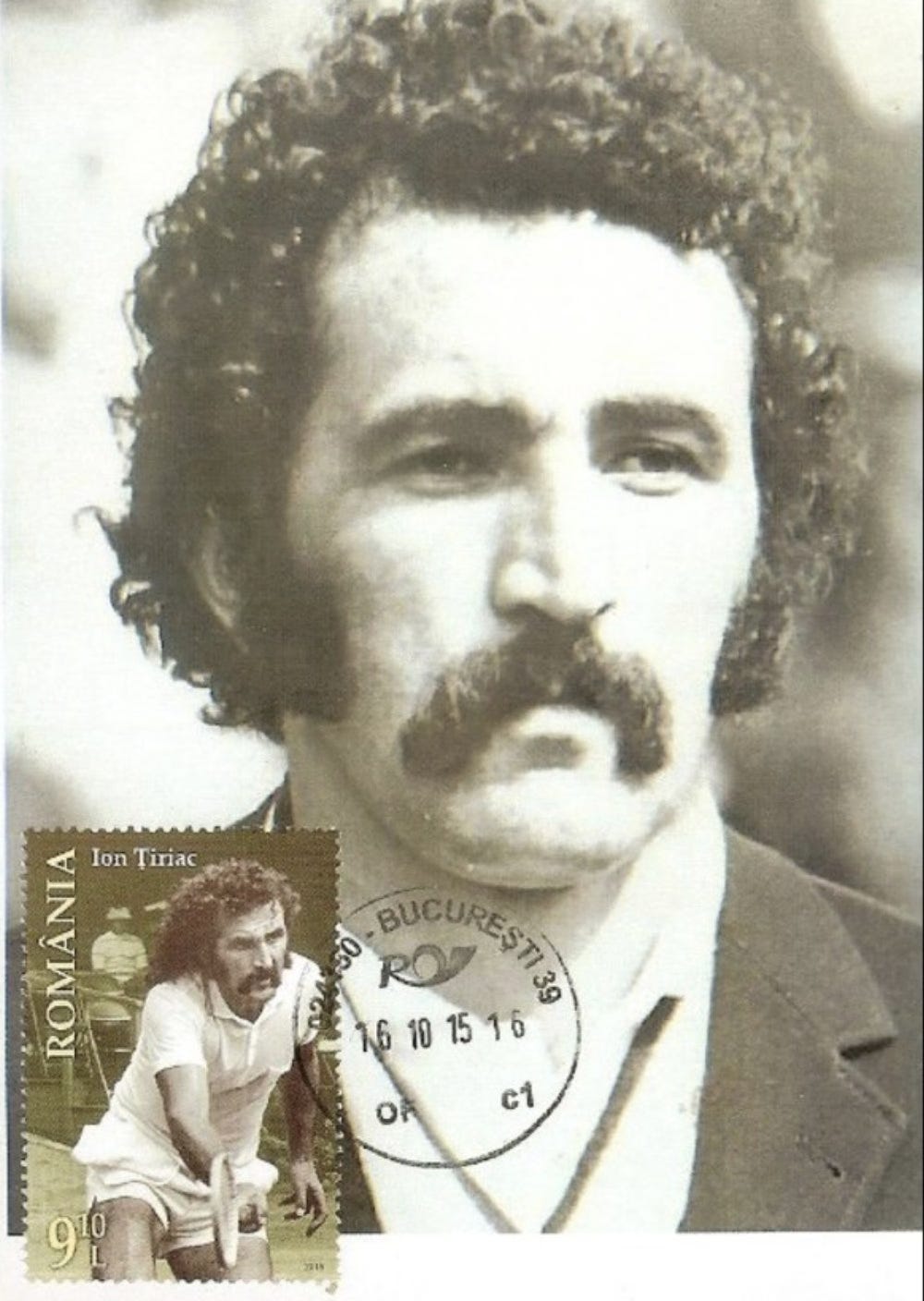
Suffice to say, “Count Dracula” was not like many of tennis’ big financial players. He operated with a level of confidence (and recklessness) that few in owner’s boxes rarely do, and it showed.
In 2004, as director of the tournament, Tiriac was the driving force behind Madrid replacing their ball kids with scantily clad fashion models — a controversial decision which has, surprisingly, remained in place to this day.
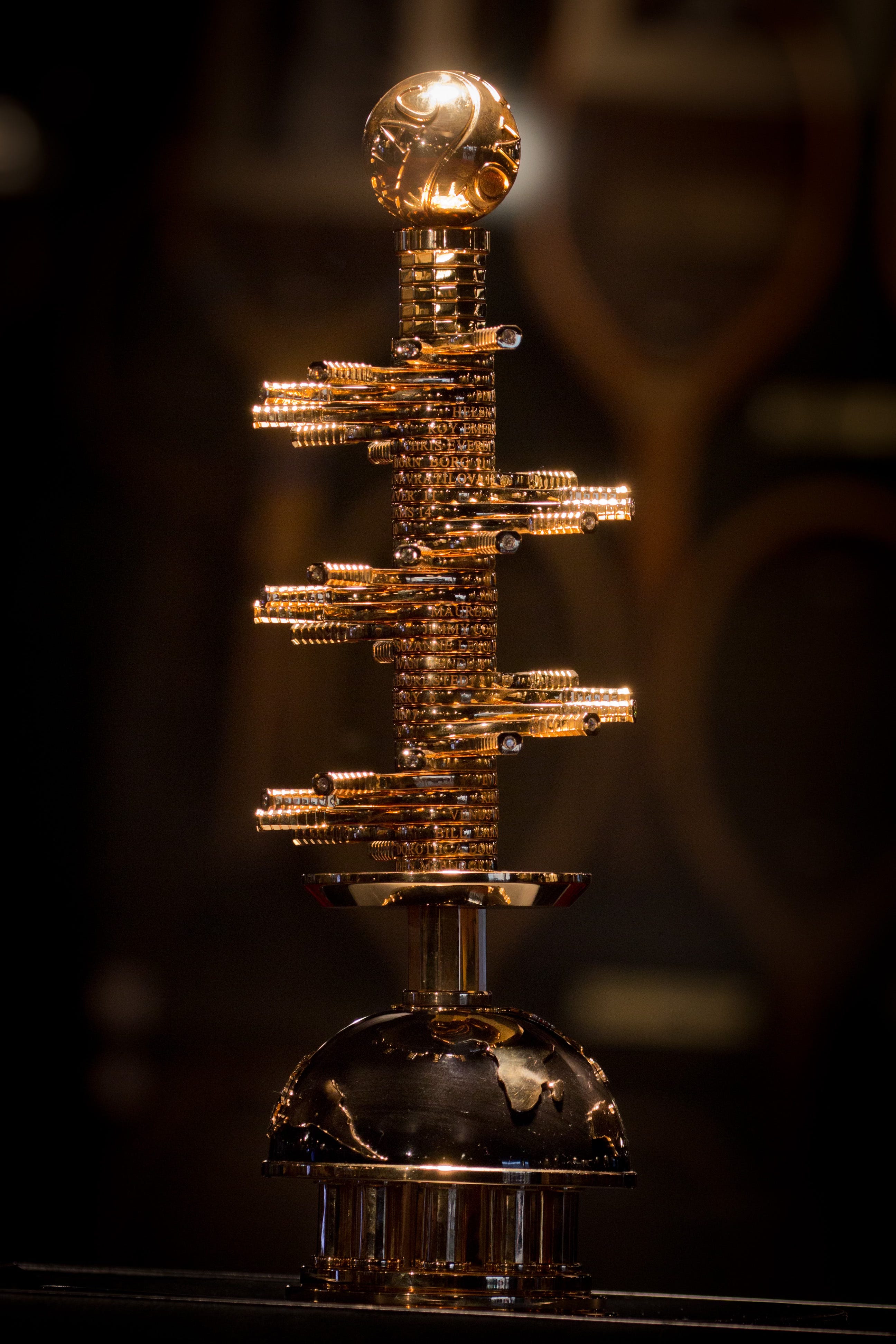
In 2011, Tiriac redesigned the tournament’s first-place trophy. Dubbed the “Stairway to Heaven”, it was built to resemble a spiral staircase, and featured several dozen miniature tennis racquets ascending a golden shaft in a concentric pattern. Topped with a tennis ball featuring Tiriac’s name in large print, some revered the trophy’s beauty, but one news outlet aptly quipped that it resembled little more than a “disturbing alien sex toy”.
Either way, the trophy was part and parcel of Tiriac’s plan to elevate the Madrid Open to a class of its own. Fashioned almost entirely out of 18-Karat diamond-encrusted gold, it cost several million to manufacture, easily making it the most luxurious trophy in tennis.
Though Tiriac’s presence was felt in several other ways, his boldest move coincided with a wave of colourful changes that hit tennis courts in the 2000s.
Motivated by longstanding complaints about ball visibility, the US Open changed the color of their courts from green to blue in 2005. This sparked a renaissance of sorts, with other marquee hard court tournaments quickly following suit.
Having changed Madrid to a clay tournament when he first purchased it in 2009, Tiriac was constantly searching for ways to improve the tournament’s experience for players and viewers alike. Believing red clay wasn't much better for visual contrast and noticing the kind of brand identity other tournaments had cultivated by choosing unique colors for their hard courts, he then set in motion a ballsy idea.
“Why not change red clay blue?”
Against the grain
Now, just to be clear — “clay” tennis courts aren’t actually made from clay.
The most common iteration of the surface, red clay, is made from crushed bricks. While not all clay tennis courts are red (some in the US and Canada are green), the colour of every clay surface is derived from the naturally occuring pigments in its building materials. What Tiriac proposed, by contrast, was a surface whose colour was achieved artificially — which had no precedent.
After receiving the go-ahead from the ATP tour, Tiriac brought it to life by effectively bleaching the brick powder and then dyeing it blue. Given the added steps involved in preparing them, the blue clay courts ended up costing nearly double what red clay typically did.
Importantly, Tiriac also stated that the characteristics of the surface were the exact same, meaning the change was entirely cosmetic. Nevertheless, the move didn’t go over well with several players, especially those at the elite level.
Rafael Nadal, the No. 2 singles player at the time — and widely known as the “King of Clay” — was the surface’s largest critic, and was outspoken from the moment blue clay was first announced.
“It’s a shame because of the history and tradition of this surface,” he tweeted. “I hope I don’t have to play one day on blue grass.”
Several other notable players voiced discontent about the change, largely because the decision was made without input or feedback from athletes. However, some welcomed it, believing blue clay to be an interesting departure from the sea of red that usually characterizes the clay season.
“I think the blue clay is a real fashion statement,” said Venus Williams, who had won the tournament in doubles two years prior. “I wish I thought of it myself.”
Despite the controversy, few could deny that the surface had immense visual appeal and was a genuine improvement in terms of contrast.
For a brief moment in time, blue clay’s novelty gave way to its practicality, and it appeared Tiriac’s gamble would pay off.
Then the weather changed.
Dropping the ball
From the start of the competition, virtually every match was accompanied by an unusual number of wipeouts.
While the surface wasn’t hazardous, it was exceedingly challenging to navigate, and it didn’t take long for players to realize that, unlike Tiriac had originally claimed, blue clay wasn’t quite the same as its red counterpart.
In fact, the surface was so different that its typical play style, which favors defensive players, was almost untenable. Aggressive hitters who minimized movement had a noticeable advantage over the players who regularly thrived on clay, flipping the script in a profound manner.
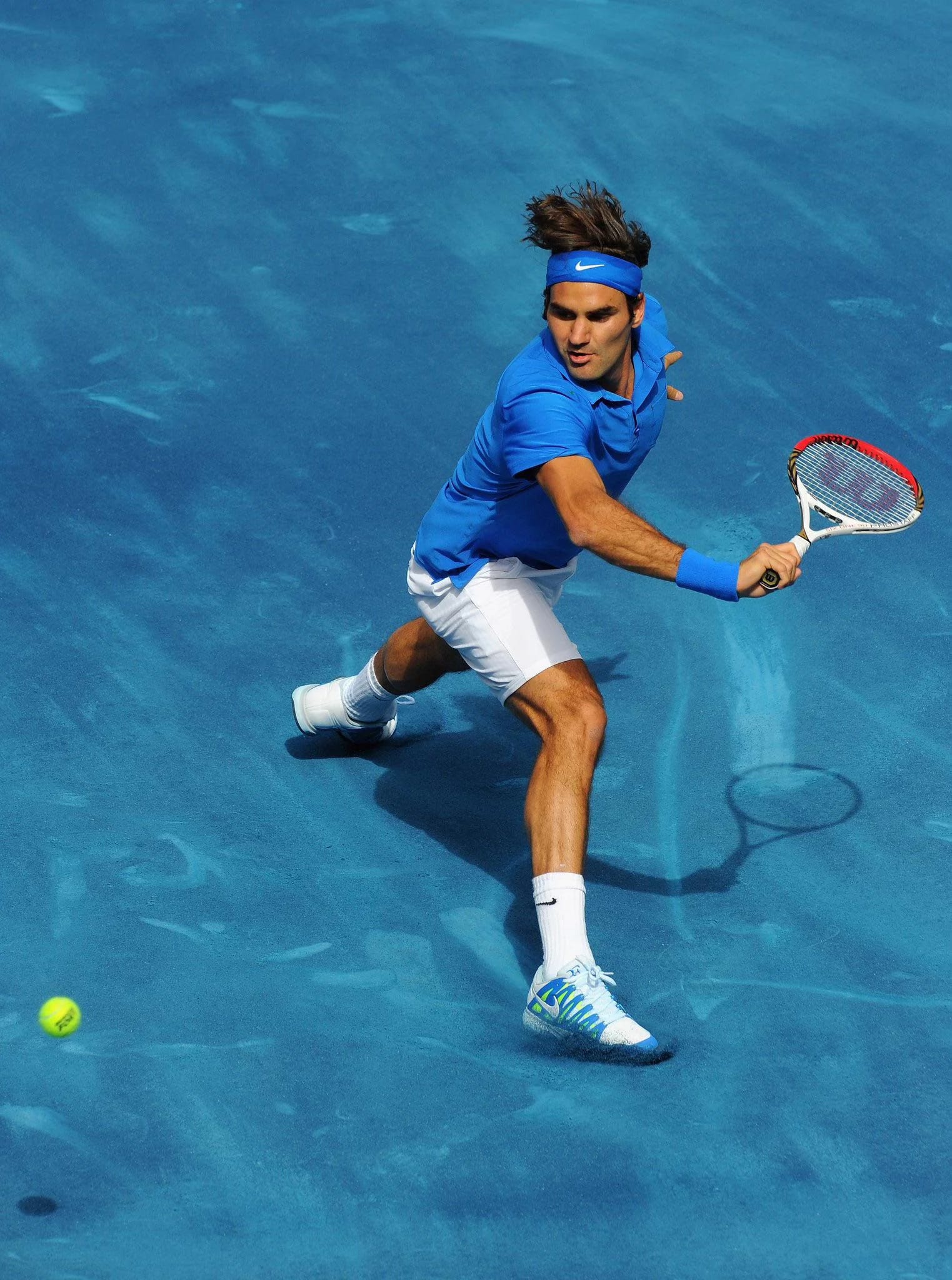
In a stunning turn of events, Nadal and Novak Djokovic, two players historically dominant on clay courts — and who had faced off in the tournament finals the year before — were both eliminated in the tournament’s earlier rounds. Their exits made way for players who, predictably, played with more power and speed than the surface usually permitted.
Naturally, complaints about the playing conditions came in droves. Djokovic went so far as to say that not a single player at the tournament actually enjoyed playing on the surface, and Federer, who went on to win the tournament, expressed his indifference too. Interestingly enough, however, Serena Williams, who won women’s tournament, was more critical of her peers than the surface itself.
“Women are way tougher than men […] We ladies don’t complain, we just do our best. On the WTA, we are real performers, we are not going out there and being weenies.”
In any case, the writing was on the wall: for all it’s beauty, blue clay was an abject failure, and a fundamentally poor playing surface.
Or was it?
Well, as it turns out, the Madrid Open had fielded complaints about its court drainage for years. Despite the implementation of blue clay in 2012, those same drainage systems weren’t overhauled (or improved) when the new surface was brought in.
So, when Madrid experienced heavy rainfall prior to competitive play, water pooled on several courts. Tournament staff salted the affected areas to reduce moisture — a normal practice in clay maintenance — but given the drainage problems, they had to overcompensate to prepare the surface in time. Consequently, when a heat wave followed the rainy weather, the blue clay, salted beyond normal, became uncharacteristically hard and uneven.
Sadly, it wasn’t until after the tournament finished that the reasons behind the playing conditions were pieced together. By that time, however, it was too late. Both Djokovic and Nadal threatened to boycott the tournament until the surface was changed back, and it didn’t take long for the ATP Tour to step in.
Just weeks after its inaugural tournament, blue clay was banned across all tournaments for 2013, and hasn’t been seen in tennis since.
Takeaways
I recently came across a quote attributed to Thomas Edison, the renowned American inventor, in which he described the mindset he cultivated in his laboratories:
“There are no rules here. We’re trying to accomplish something.”
Tennis is a sport notorious for its resistance to change. It's steeped in tradition, and alterations of any kind — whether cosmetic or otherwise — are almost always met with pushback. This resistance preserves the essence of the game, yes, but it also tends to discourage innovation, and deprives fans and players of potential changes that could genuinely improve the sport.
Ion Tiriac tried to accomplish something by turning clay blue. Although some regarded it as a shallow marketing ploy — driven more by shock-value than anything else — there’s no doubt that blue clay, as an idea, had merit. Not only was it a relatively minor change (in theory), but it was also something that could’ve opened the door for more out-of-the-box thinking in tennis.
That being said, Thomas Edison also has another quote worth mentioning here:
“Vision without execution is hallucination.”
For all Tiriac’s vision, creativity, and boldness, the execution of blue clay was a travesty. If the tournament had adequate drainage systems — which they later did, to the celebration of many — there’s no telling what kind of impact blue clay could have had on the sport. And that’s the real shame.
Marketing is a game of attention, but once you get that attention, you must offer something worthy of that attention. Otherwise, you’ll end up a victim of your own success. Advertising great Jerry Della Famina once expressed the same idea in a brilliantly succint way:
“Nothing kills a bad product faster than good advertising.”
Game. Set. Match.